A War Seen From Above
Aktualisiert: 3. Juni
In the fields of Zaporizhzhia, Ukrainian reconnaissance crews track movement, guide strikes, and adapt to a battlefield where drones reshape distance, timing, and survival.
Published in the Kyiv Post March 22, 2026

Along the southeastern front in Ukraine, a war shaped from above is unfolding. For Ukrainian drone crews operating here, the battlefield is defined less by fixed positions than by what can be seen, tracked, and anticipated. As both sides adapt, distance offers less protection, timing becomes critical, and the line between front and rear is increasingly blurred.
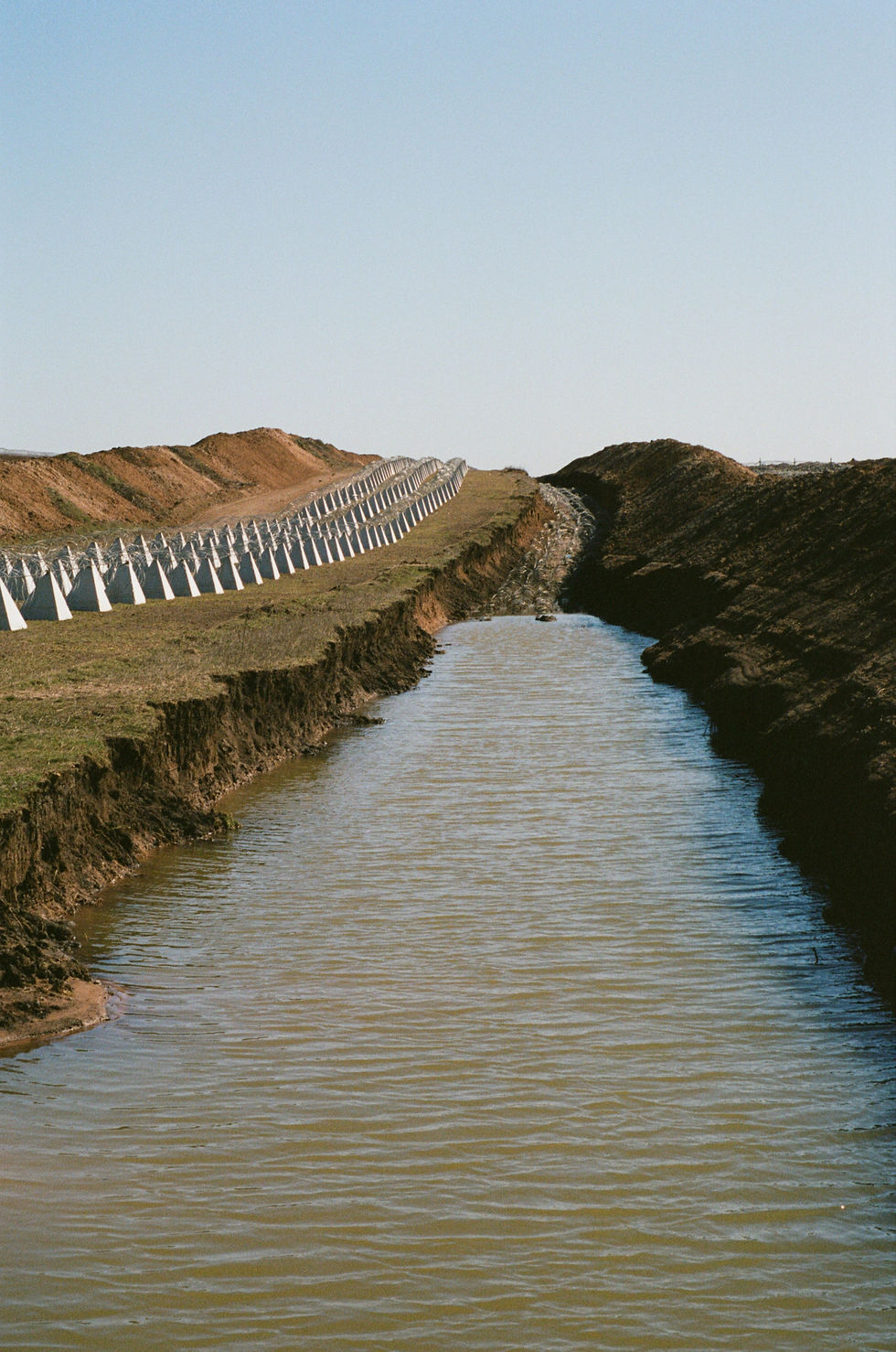
An hour east of Zaporizhzhia, the road begins to change from open countryside to fortified ground. At first it is only a detail here and there: a trench cut into the earth, coils of barbed wire, a mound of fresh soil at the edge of a field. Then the defenses thicken with every mile. More ditches. More prepared positions. More checkpoints. Anti-drone nets begin to stretch over sections of the road, draped low and tight like improvised ceilings above the asphalt. The closer one gets to the front, the more the landscape appears to brace itself.

Beneath the surface
It is mid-March in Zaporizhzhia region. The sky is bright blue. The fields are wide and, in another life, could be almost serene. Winter has loosened its grip and the air feels mild. But somewhere ahead, beyond the tree lines and the open land, smoke is rising. The sound of explosions, faint at first, grows clearer with every passing mile.
Then our car turns off the road and stops by an unremarkable patch of land between the trees.
There is little to suggest that anything military is hidden here. No sign, no bunker line, no visible infrastructure – only the entrance to a dugout cut into the ground. Bob and the two men on his crew, Artic and Quill – part of a reconnaissance drone team – had begun their multi-day stint the day before. For several nights, this hole in the earth becomes home.
By the time the first flight is prepared, the sun is already sinking. A pale lilac glow lingers above the horizon before fading into red. Outside, the team moves with the quiet routine of men who have done this many times before. Their aircraft is a Leleka – Ukrainian word for stork – a fixed-wing drone launched into the dark not to strike, but to watch.

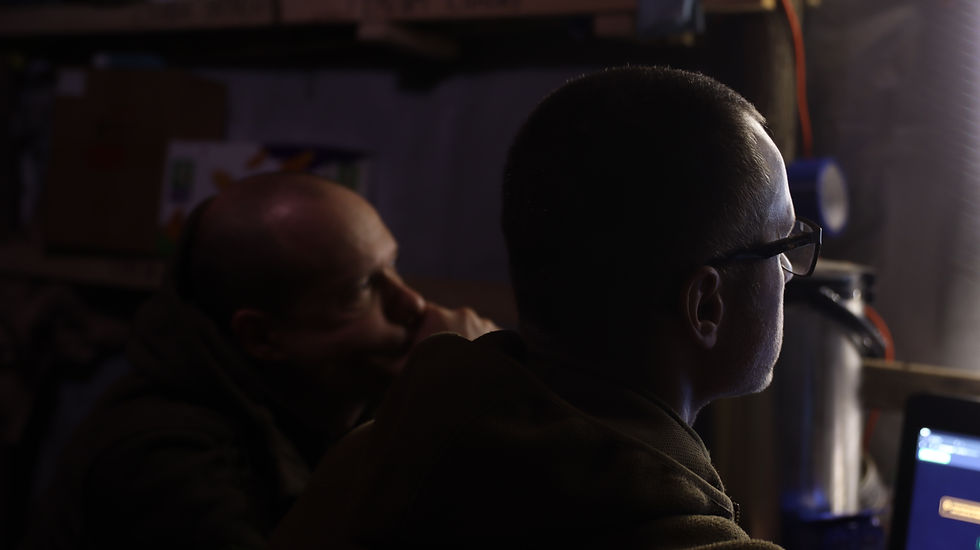
Inside the dugout, the space is narrow. A few screens cast cold light across the walls. There is barely enough room to stand upright. Bob, who mentioned that the shelter had been full of mice only weeks earlier, settles back in front of the monitors. One man flies the aircraft and another works the camera. A third stays with the stream, in contact with commanders following the same live feed from their bases. “They see exactly what we see,” Bob says.
This is how the war is fought now: a buried chamber of screens, cables, antennas and scattered batteries. The crew inside is safer than infantry troops on the zero line (at the very front), but not safe, as Bob stresses. Safety here is always relative. A drone can still find them and a lapse in attention can still kill.
“Staying invisible means staying alive,” he says.
Part of the chain
The unit, part of the 1st Company of the “Scythian Griffins” – the 423rd UAS Battalion – focuses primarily on aerial surveillance. Their drones are not just gathering information but are part of a chain. Targets identified here can be passed on to artillery units, FPV teams or other strike elements. Fire can follow within minutes, depending on availability. “We can support any strike,” Bob says. “Whatever is close and can work.” Their task is to search for Russian artillery positions, movements, shelters, signs of life, even a generator – anything that might matter to assault units operating in the same sector. “We’re not bombing. Not tonight,” Bob points out.
On the monitor, the image is grainy but precise enough. A tree line; a narrow path cutting through brush. Heat signatures flicker faintly. Somewhere out there, in the darkness, people are moving.
Ukrainian fixed-wing reconnaissance drones are vulnerable to detection and targeting, particularly by Russian first-person view (FPV) drones that have become increasingly effective. Several losses forced units like this one to adjust their routines. “If we lose our planes, we lose everything,” he says. These aircraft are far more expensive than the small Russian FPV drones used for strikes. Losing one matters. Night does not eliminate that risk, but it reduces exposure.
Small groups, high losses
Ground movements now reflect the constant presence of drones. According to Bob, Russian forces have adapted their behavior in response to constant aerial surveillance. The enemy’s heavy vehicles rarely move freely close to the line anymore, he says, since they know their tanks and armored units are too easy to detect and too easy to destroy.
Instead, small groups of Russian soldiers often advance on foot, slipping through tree lines, fields and along narrow paths, trying to stay unseen until they can regroup underground and prepare for an assault.
It is a slow, grinding way of pushing forward. Inefficient in human terms, but effective nonetheless. Out of a hundred men sent in that direction, Bob estimates, perhaps 20 make it.
“They have results,” he says of Russian forces. “But they lose a lot of people.”
From above, these movements are easier to read: figures approaching cover, then vanishing from view. Reconnaissance means recognizing such developments early, before they turn into coordinated action.
When movement becomes possible
Timing plays a role as well. Russian soldiers avoid moving at night, relying instead on the brief gaps between drone cycles. “They try to use blind spots in the morning or in the evening,” Bob says, “when drones need to go back to change batteries or adjust cameras.” These are short windows; moments where the sky is less closely watched. That is when movement becomes possible for Russian troops. “It’s crazy,” he says. “People think about when the enemy changes battery.”
Outside, the sky is clear enough to show every star. In peacetime, it might have been called a beautiful night. Here it is only a useful one. The front line is close enough to be felt; announcing itself in flashes and distant thuds. Close enough to matter but far enough to create a strange kind of distance. Each time the dugout is left, movement follows a pattern: staying close to cover, avoiding open ground, watching the sky and listening. A buzz overhead leaves no time to hesitate. Everything that flies could be a threat.
Two months earlier, Bob says, a unit was caught during a rotation. A Russian Lancet drone struck a vehicle. Two comrades were killed.
When the Leleka returns, the crew steps out into the dark to recover it from the field, swap batteries, change equipment, pull data, and send what has been gathered back up the chain. Then the aircraft goes up again. The night is divided into these cycles: flight, return, relaunch. Every minute is calculated.
“The problem is manpower”
The rhythm is mechanical, repetitive and necessary. “If we don’t see anything,” Bob says, “we still need to do this.” The system depends on persistence and it also depends on people. “We can buy a lot of planes,” he stresses. “But we don’t have a lot of people.” It is a point he returns to more than once. Drones, he insists, are not the limiting factor – operators are. Ukraine does not lack machines but lacks hands to control them. “We need more eyes in the sky,” Bob emphasizes. Training, he says, is not the barrier. “To teach one man it takes a couple of weeks, that’s it.” The problem is manpower – and perception. Many still associate military service with the infantry, with direct combat at the zero line. But that is no longer the only reality. “People think they will go to trenches,” Bob says. “But now, it’s different.”
In many cases, he explains, infantry units are no longer primarily engaging the enemy directly, at least not in the way they once did.
“It’s not always about shooting anymore,” Bob says. “Often it’s about watching and telling pilots where the enemy is.” Coordinates are passed. Drones are launched from a distance. Strikes follow. War is increasingly conducted through layers of observation and remote engagement.
“This is a war of drones,” he says. “Definitely.” Even defense is becoming automated, at least in theory. But the system still needs operators.
Not feeling useless
Bob joined the Armed Forces of Ukraine (AFU) in 2024. After Russia launched its full-scale invasion, he first fled west with his family, hoping the war might end quickly. When it didn’t, he decided to enlist. “I understood that if I don’t do something, nothing will happen,” he says. His wife and children have returned to their hometown of Mykolaiv. They speak every day, via video call whenever possible, or occasional visits when he rotates back to Zaporizhzhia.
His shifts follow a strict pattern: a period in position, followed by time to reset. Usually enough to recover, he says. At least for now.
“She understands,” he says, referring to his wife. “I’m not on the zero line.” It is, as he calls it, “so-so safety.” Before the war, Bob worked as an engineer, later as a freelancer – organizing projects, building small teams, moving from data entry to more complex technical work. Now, his work is different, but the logic remains. Problem. Solution. Adaptation.
“Now I’m not feeling useless. Still, there is a limit somewhere. But I can’t tell you where my red line is,” he says. “Sometimes it’s like waves. One day you say, ‘I hate it, I want to go home.’ Next day, it’s okay again.” He shrugs. “There are not many people who do this,” he adds. The implication hangs in the air. “If I go, maybe more people go.”
The night is almost over. The Leleka circles again over occupied territory. A third coffee is boiling on the small gas stove. Tired eyes remain fixed on the screens. What unfolds is a battlefield increasingly shaped from above.
Toward morning, the black sky begins to soften and the stars disappear one by one. Somewhere beyond the dugout entrance, the fields of Zaporizhzhia are turning visible again.
Where missions are prepared
Back in the city, the work does not slow down. In Zaporizhzhia, the war continues in a different rhythm. It’s early evening and air raid sirens cut through at irregular intervals. Somewhere in the distance, explosions roll across the horizon, dull and familiar. Inside a low, nondescript building, lights are still on.
This is where another part of the same war is being prepared.
Rooms are crowded with equipment: stacked crates, coils of cable, batteries arranged in rows, and components laid out on tables. In one corner, a fixed-wing drone rests between cases and tools. Men move constantly through the space, lifting, checking and packing. Someone tightens a screw. Someone else carries a box past the table where two soldiers sit, talking through the next mission.
They are part of the same battalion – the same company and the same structure.
“My call sign is Staryi,” says a man in his early thirties from Luhansk region. “It means old man.” He allows himself a brief smile. Next to him sits Sych, 36, originally from Kharkiv, who spent most of his life in Kyiv. His call sign, he explains, was given to him by his wife – a reference to a little owl.
They work together in a Shark crew, another fixed-wing reconnaissance drone system designed for longer-range observation.
“I’m the operator and the commander of the crew,” Staryi says. “And I’m the mechanic,” Sych adds. “I prepare the aircraft for takeoff, then launch it, and receive it when it lands.”

The division is clear, almost surgical. Software and command on one side; hardware and execution on the other.
Before the full-scale invasion, their lives had little to do with war. Staryi worked in digital marketing. Sych was part of IT-related projects connected to the Ukrainian parliament, dealing with systems and infrastructure rather than weapons. When the war began, both tried to find their place in a military that was still adapting to the scale of what was coming.
Staryi was not taken at first. He lacked experience – skills considered immediately useful. Through contacts, he later joined a small group that would become part of the battalion as it was forming. “We were about ten people in the beginning,” he says.
Sych took a different path – first, working on digital projects for the military, then learning how to fly and to build drones. With an aviation background, the transition to fixed-wing systems came naturally.
Both ended up here, in a setting that demands increasing specialization. They can work with different systems, Staryi explains, including Mavics, FPV drones and bomber units.
“You can do a bit of everything,” he says. “But it doesn’t work well. It’s more effective when you focus on one thing.”
Feeding the strike
Like Bob’s crew, their work is centered on reconnaissance: seeing, following and confirming; to find targets and to make sure that when something is hit, it is actually destroyed.
In recent months, that has meant concentrating on a specific layer of the battlefield: logistics, from supply routes and vehicles to movements behind the line.
As a small team within a larger system, they work alongside missile units, long-range strike systems, and other fixed-wing operators, providing the eyes that guide and verify.
Unlike the Leleka crew closer to the line, their missions can begin from further back, allowing them to relocate quickly when needed.
From there, the Shark is launched using a catapult – a heavy piece of equipment that must be transported, assembled, and aligned. Landing is no less complex, with the drone returning by parachute.
“What worries me most is folding the parachute correctly,” Sych says. “If you do it wrong, the drone can crash.”
After landing, the team has to move quickly, retrieving the aircraft and parachute from open ground before carrying them back toward cover. In those moments, they are exposed. Not as pilots, not as observers, but as men standing in a field with equipment in their hands.
The missions themselves can last for hours. Seven is possible. But flight time is only part of the calculation. Preparation, transport, and coordination with other units can stretch a single operation well beyond ten hours.
Conditions and constraints
Everything depends on conditions. Electronic warfare is a constant factor. Signal jamming, more than spoofing, remains the primary threat. Different systems react differently, and not all adapt at the same pace.
But even more decisive is something simpler – the weather. Fog, rain or snow all limit visibility from the air, reshaping the battlefield in ways no system can fully compensate for.
“It’s not about better drones,” Staryi says. “You can’t do everything with drones.”
When the sky closes, the ground opens. Vehicles that would be quickly detected and destroyed in clear conditions can move under cover of weather. And where drones cannot see, the burden shifts back to people – often too few of them.
“When you have maybe 15 soldiers covering five kilometers,” Staryi says, “you can’t control everything.”
Drones extend that control; they do not replace it. The war they describe is one that has changed not only in technology, but in scale and proximity.
“It’s much harder to stay undetected now,” Staryi says. “And if you are detected, it’s much harder to stay alive.”
He pauses, then adds, more concretely: “Artillery may land somewhere near you. An FPV comes straight at you.”
The difference is not theoretical. It defines how soldiers move, when they move, and whether they move at all.
“A year ago, you could step out, smoke and drink coffee. Now even 20 kilometers can be dangerous,” Staryi notes. The zone of danger has expanded. So has the pressure.
“You just need to do your job”
The same pattern appears again as Staryi and Sych describe their own observations: Russian soldiers moving forward in small groups, on foot. High casualty rates, as they put it, do not necessarily stop an advance, only slow it down. “They had very high losses,” Staryi says. “But they still carried out successful offensive actions.”
It is the kind of reality that leaves little room for illusions. Speculation about political shifts, about collapse, or about decisive external intervention – these are not things he relies on.
“I try not to think that Putin will die, or that Russia will collapse, or that someone will give us a thousand Tomahawks,” Staryi continues. “You can’t count on that.”
Instead, the focus remains narrower – both immediate and practical.
“You just need to do your job.” Next to him, Sych nods. “We see what happens when Russians come. We know what it means,” he says.
Outside, the siren sounds again, rising over the city, then fading. Inside, the work continues.
For those following the war from a distance, Sych has a message that is as direct as anything said that evening. “They should understand that the war is close to them,” he says. “It can reach them in a few years.”
Staryi goes a step further. “They should not forget that this war continues,” he says. “And they should prepare for war in Europe.”
In the room behind them, someone closes a case. Another box is lifted, carried toward the door. The drone on the table remains where it is, waiting.
Somewhere beyond the city, the line still holds.
A village under fire
In Novomykolaivka, a small village almost 70 kilometers (about 43 miles) from Zaporizhzhia, that line feels much closer. Houses stand torn open, walls blackened, roofs collapsed inward. In one yard, a car stands burned out, its frame twisted and windows gone. A motorcycle with two soldiers passes at speed, disappearing down the road.
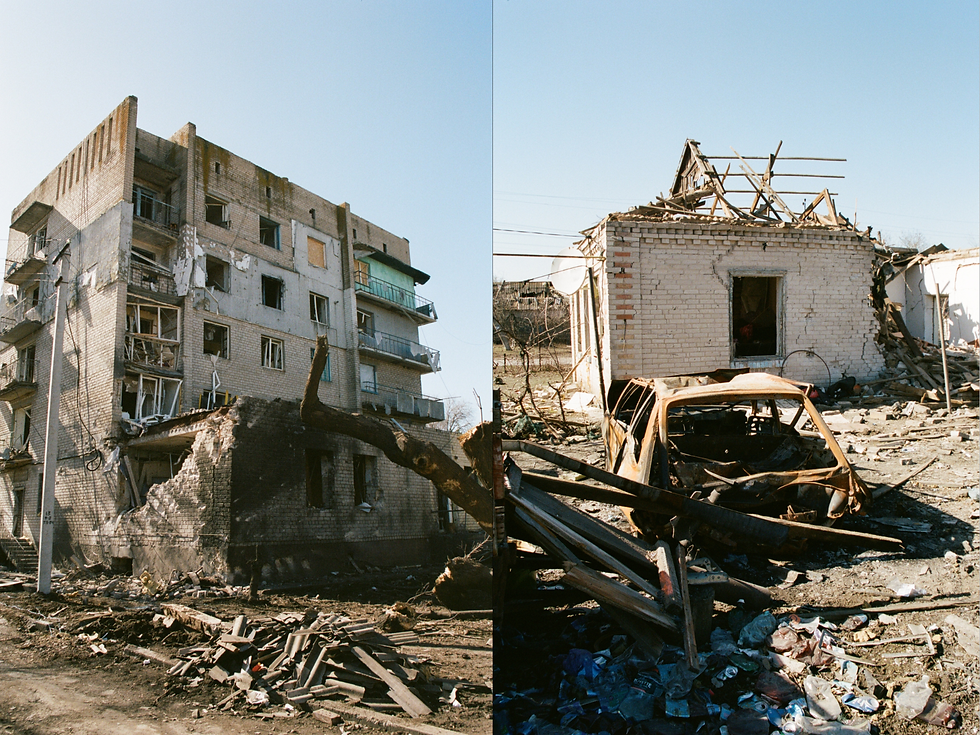
There are still a few civilians. A woman walks along the roadside, carrying a bag. In front of the town hall, where the windows have been replaced by rough wooden boards, a man and a woman stand at the edge of a crater, raking the loose earth back into place. Someone says the strike came two weeks ago – a guided bomb.
COMBO: Novomykolaivka, Zaporizhzhia region – residents rake earth near a crater in front of the boarded-up town hall (left) and a pair of abandoned shoes in front of a destroyed house (right), March 13, 2026.
Air raid sirens rise and fall without urgency. No one stops.
From journalist to soldier
At its center, a soldier slows near the old post office and steps through the broken entrance. Inside, the floor is covered with shattered glass. The room is stripped down to its structure. The outlines of the past are still visible: counters and partitions – a place that once organized the ordinary flow of things.
The soldier sits down on one of the old waiting benches. Sunlight falls in through the broken windows, catching dust in the air.
“Call me Zhyvchyk,” he says. “It means something like a pulse. Always moving. Never still.”

The 39-year-old was born in Kyrgyzstan, where his family had been deported during Soviet times, facing repression, imprisonment, and displacement across generations. He returned to Ukraine after the Revolution of Dignity in 2014. For years, he worked as a journalist, then later in television covering politics, society and everyday life.
Today, like the others, he works with fixed-wing reconnaissance drones. In his case, Vector systems – German-built platforms designed for quiet, long-range observation, capable of vertical takeoff and extended flight times.
The decision to enter the AFU was his own. Zhyvchyk looked for a specific battalion, chose one, and joined. He calls drones the peak of modern warfare. “You need to understand the equipment. It’s more like an intelligence job,” he says.
His days begin early. “We wake up before dawn.” From there, the hours stretch. Ten, sometimes twenty. Watching, scanning, passing information on to other units coordinating strikes.
What Zhyvchyk describes aligns with what others along the front have already observed: the range of drones increasing, the distance between danger and supposed safety shrinking.
“Two years ago, FPVs reached maybe five kilometers. Now it can be 15.”
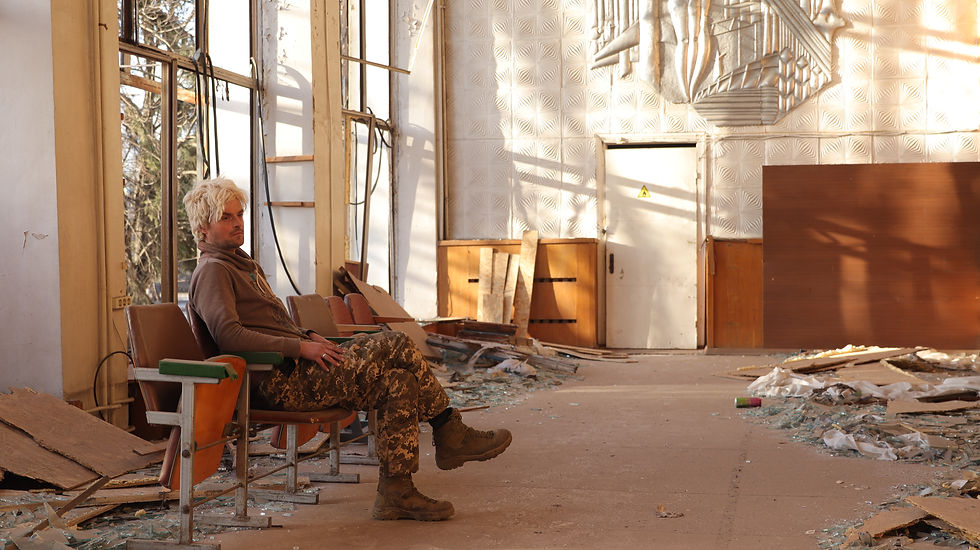
Zhyvchyk leans back slightly on the bench. “Before, we had only our guns and our ears,” he says. Now there are other systems, signals, warnings and screens that show what is coming before it arrives. “It’s a lot of small decisions,” he adds. “But they are very effective.”
The war will continue
Zhyvchyk does not expect the war to end soon. “Honestly, I have my doubts. It will probably be frozen,” he says. “Five, maybe ten years.”
As long as Russia has people, money, and technology, it won’t stop, he believes. The answer is not to wait for something external to change that, but to adapt faster.
“We need to be ahead of them,” he says. “More clever, more modern.”
He pauses, looking toward the doorway. “I’m fighting to be Ukrainian. To speak the Ukrainian language. To remain who we are.”
Outside, the siren starts again. For him, the wider world, negotiations, shifting alliances and new conflicts like in Iran, feel distant and abstract. What matters is closer and more immediate – the work in front of him, the next flight and the next adjustment. “We just continue,” he reaffirms. Zhyvchyk looks out toward the street and the damaged buildings. “You never know when it will come to your country,” he says. “You should always be prepared.”
He lingers for a moment, then stands, stepping back through the broken doorway into the street. A military pickup is waiting for him. The next shift is about to begin.
For now, the fields of Zaporizhzhia remain a place where the future of this war is being tested, flight by flight.